There is a silent agreement in every house. When you close a door, the world behind it ceases to concern you. When you turn off the light in your bedroom, what happens inside belongs only to you. When you enter the bathroom, your body owes no explanations to anyone.
Written by
MOVA Studio · Architecture & Interior Design
An Athens-based studio shaping spaces where architecture, interior design and craft meet — notes from our practice.
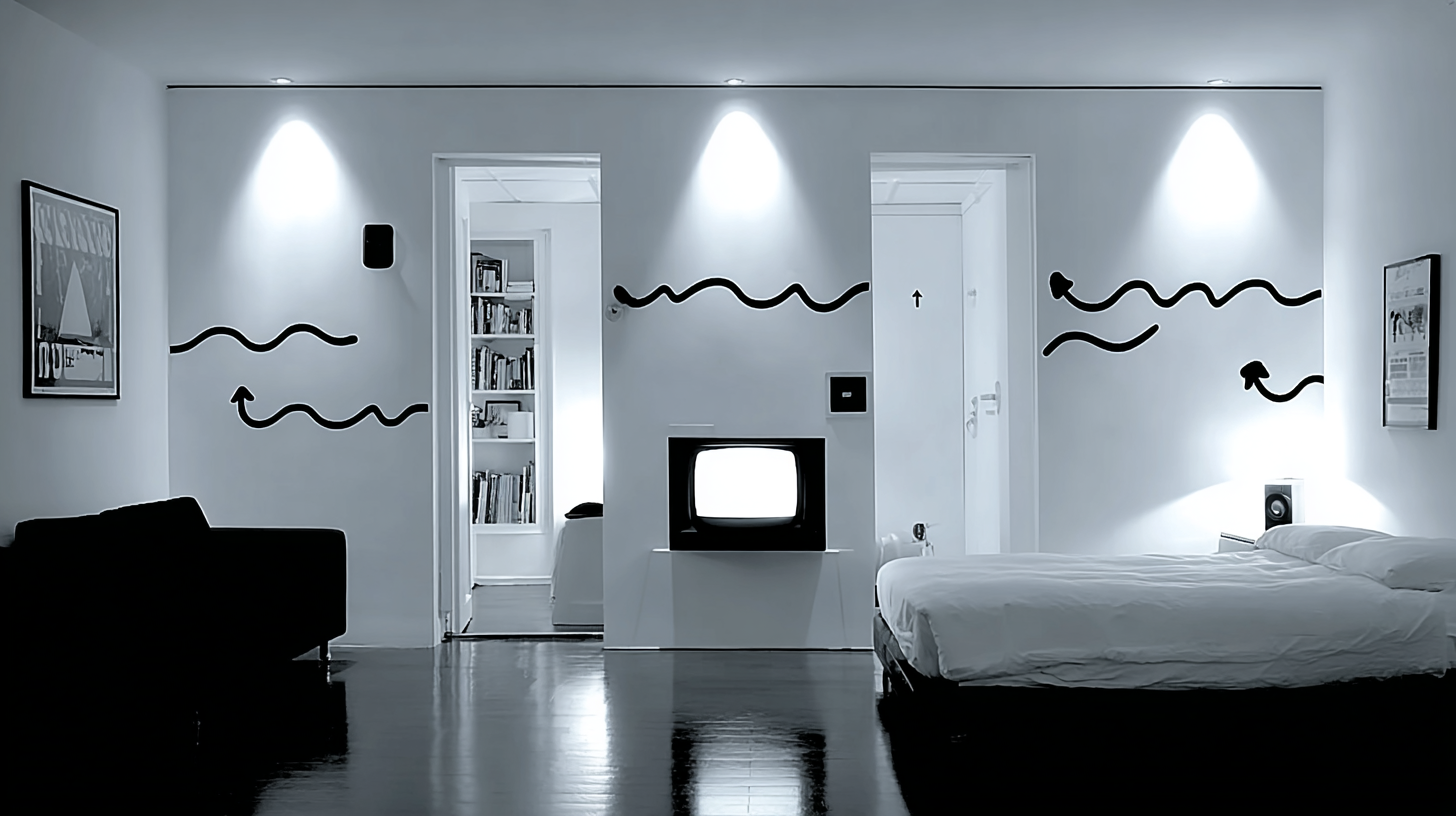
This agreement is a deception. In thousands of Greek apartments, the door closes but the sound does not stop. The wall separates visually but unites acoustically. The bathroom hides the body but exposes its sound. We live in homes that promise us privacy and never deliver it.
This article is not about soundproofing in the technical sense. We will not talk about decibels, Rw indices, or types of plasterboard. We will talk about what happens to the people who live behind walls that hold nothing back. About the sleep that never comes. About the relationship that erodes. About the child who hears what they shouldn't. About the couple who does not feel free in their own bed.
We will talk about the greatest design failure of the Greek residence. And about the fact that no one calls it a failure.
Noise doesn't just disturb. It sickens.
Let's start where no one wants to look: the data. Because noise inside the home is not a "matter of tolerance." It is not "something you get used to." It is a factor of disease.
Nineteen years of monitoring. Over 31,000 people. The largest longitudinal study ever conducted on noise and mental health in the home concluded with a result that leaves no room for doubt: indoor noise is consistently linked to a deterioration in mental health. Not "eventually." Not "in extreme cases." Consistently. And when noise decreased, mental health improved. This means noise doesn't scar you because it must. It scars you because no one designed your space correctly (Li, Martino, Mansour & Bentley, 2022, American Journal of Preventive Medicine, 63(2), e39–e48).
And don't think we are talking about "stress" in the loose, everyday sense. We are talking about neuroinflammation. Cerebral oxidative stress. Increased catecholamines. Disruption of circadian rhythms. Nighttime noise doesn't just wake you up. It alters your brain chemistry into a state that clinically resembles an anxiety disorder (Münzel et al., 2024, Journal of Exposure Science & Environmental Epidemiology). Sleeping next to a road without soundproofing? Your brain never rests. Not even when you don't wake up.
In apartment buildings, the problem multiplies. Footsteps, dragging furniture, running children, televisions, arguments: a recent study of 400 apartment residents found that even at low noise levels, sensitive individuals exhibit increased blood pressure (Park & Lee, 2026, Journal of Exposure Science & Environmental Epidemiology, 36, 398–408). You don't need to hear your neighbor shouting. It is enough to hear them existing.
A wall that does not acoustically isolate is not a wall. It is a stage set.
The home that won't leave you alone
Noise is only half the story. The other half isn't heard, it's felt: it is the inability to be alone within your own home.
Think about your day. You wake up and hear everyone. You talk on the phone and the kitchen broadcasts every word to the living room. Your son hears the conversation that does not concern your son. You want five minutes of peace and there is not a single spot in your home that grants it.
This is not a matter of character or "patience." It is a structural failure. Environmental psychology has known this for fifty years: privacy is not a luxury. It is a biological necessity. Humans function in alternating cycles of social contact and isolation. Remove the possibility of isolation and you don't remove a "comfort," you remove a mechanism of psychological regulation (Altman, 1975, The Environment and Social Behavior, Brooks/Cole).
What happens when this mechanism breaks? A study of student roommates provided an answer that should worry every residential designer: after six months in high-density conditions, residents didn't just become dissatisfied. They withdrew socially. And that withdrawal didn't stay at home. It carried over everywhere—into every relationship, every meeting, even in spaces with no crowding at all. The inability to be alone in your home makes you lonely everywhere else (Evans & Lepore, 1993, Journal of Personality and Social Psychology, 65(2), 308–316).
During the lockdown, 1,246 families in England and Scotland were surveyed. Over 70% stated they could not find time and space for themselves. Over half reported increased family tension. Children sharing a room were disproportionately affected (Pattinson, Costa Santos, Parnell & Sarhan, Newcastle University / University of Dundee). The pandemic didn't create the problem. It revealed it. These homes were always inadequate. It's just that no one was locked inside long enough to admit it.
The same researchers coined something that every architect must stop and read: "parallel proximity." The ability to be together but alone. To share space while focused on your own activity, without sound and presence becoming oppressive. This doesn't require a larger house. It requires a better-designed house.
The bathroom, the bed, the truth no one tells
So far we have spoken about mental health, social withdrawal, family tension. But there is something deeper, something not written in architectural studies but lived every day. The body. And the relationship of two bodies within a space that does not protect them.
The toilet. No soundproofing, no sound absorption, nothing. Every family member is acoustically exposed to something that belongs exclusively to their body. This is not an aesthetic issue. It is a matter of dignity. A bathroom door that lets every sound through does not offer privacy. It offers only a visual barrier. And if you think this is a "detail," ask yourself why you turn on the faucet.
And now let's talk about the bed. Clearly.
A couple needs to feel free in their own bedroom. Without being heard. Without wondering if they are being heard. Without checking if the children are asleep, if the neighbor is home, if the wall holds. This freedom is not a luxury. It is a prerequisite for an erotic life.
A study during the lockdown in London explicitly examined this issue. Nearly one in three participants reported a negative impact of the acoustic environment on their sexual activity. The sounds of children, neighbors, and roommates created embarrassment, frustration, and anxiety. The psychological logic was revealingly simple: "hearing someone means someone hears me." Conversely, a quiet, soundproofed environment created a sense of safety, intimacy, and freedom of expression (Torresin, Ratcliffe, Aletta, Albatici, Babich, Oberman & Kang, 2022, Frontiers in Psychology, 13, 1038303).
Clinically, the relationship is even harsher. In a sample of 3,736 men who visited a sexual dysfunction clinic, the lack of sexual privacy acted as a predisposing, aggravating, and maintaining factor. The presence of children in the same or adjacent room without acoustic isolation altered sexual dynamics, often permanently (Boddi, Fisher, Maseroli, Rastrelli, Corona, Jannini, Ricca, Mannucci & Maggi, 2014, Journal of Sexual Medicine, 11(2), 431–438).
A couple that does not feel free in their own bed does not need a marriage counselor. They need an architect.
Children hear everything. And they don't forget.
Homes are designed by adults, for adults. But children live in them. And children cannot close their ears.
A child uses the home to study, to play, to sleep, to develop an identity. Each of these requires some form of acoustic protection. And none of them exist in the average Greek apartment.
The evidence leaves no doubt. Living in crowded conditions negatively affects school performance, behavior, and physical health, regardless of socioeconomic level. Less than one extra person per room is enough to measurably lower math scores (Solari & Mare, 2012, Social Science Research, 41(2), 464–476). But it's not just square footage. It's what is heard through the walls.
A child who hears their parents arguing, with no way to "turn off" the sound, is in a state of permanent involuntary exposure. They don't choose to hear. The space forces them. A child without an acoustically protected room has nowhere to withdraw. And the inability to withdraw does not produce resilience. It produces alienation (Evans & Lepore, 1993).
A child who grows up without personal space does not learn to share. They learn that boundaries do not exist.
This is not a luxury. It is the minimum.
Noise that sickens. Privacy that doesn't exist. Couples who feel trapped. Children who are exposed. None of this is fatalistic. All of it is a result of design—or more accurately, the absence of design.
Every time a house is designed without soundproofing in the bedrooms, without acoustic isolation in the bathroom, without the ability to shut a door that actually closes, the designer is making a decision. They may not know it, but they are deciding that this family's sleep isn't worth it. That this couple’s relationship isn't worth it. That this child’s mental health isn't worth it.
Soundproofing is not an optional upgrade. A bedroom without acoustic isolation is not a private space; it is an open space with a door. A bathroom that can be heard in the hallway does not serve its function. A floor plan that allows no one to be alone was not designed for people. It was designed for square meters.
The architect does not design walls. They design the conditions within which a family will function or erode. They design whether a couple will feel free or trapped. Whether a child will have a place to withdraw or will learn to withdraw from everything. Whether a person will close a door and know that it is truly closed.
This is not aesthetics. It is not luxury. It is the minimum.
Sources
Altman, I. (1975). The Environment and Social Behavior: Privacy, Personal Space, Territory, Crowding. Brooks/Cole.
Boddi, V., Fisher, A. D., Maseroli, E., Rastrelli, G., Corona, G., Jannini, E. A., Ricca, V., Mannucci, E., & Maggi, M. (2014). Lack of sexual privacy affects psychological and marital domains of male sexual dysfunction. Journal of Sexual Medicine, 11(2), 431–438.
Evans, G. W., & Lepore, S. J. (1993). Household crowding and social support: A quasiexperimental analysis. Journal of Personality and Social Psychology, 65(2), 308–316.
Li, A., Martino, E., Mansour, A., & Bentley, R. (2022). Environmental noise exposure and mental health: Evidence from a population-based longitudinal study. American Journal of Preventive Medicine, 63(2), e39–e48.
Münzel, T., et al. (2024). Noise and mental health: Evidence, mechanisms, and consequences. Journal of Exposure Science & Environmental Epidemiology.
Park, S. H., & Lee, P. J. (2026). Effects of noise on health-related quality of life. Journal of Exposure Science & Environmental Epidemiology, 36, 398–408.
Pattinson, E., Costa Santos, S., Parnell, R., & Sarhan, H. At Home with Children project. Newcastle University / University of Dundee.
Solari, C. D., & Mare, R. D. (2012). Housing crowding effects on children's wellbeing. Social Science Research, 41(2), 464–476.
Torresin, S., Ratcliffe, E., Aletta, F., Albatici, R., Babich, F., Oberman, T., & Kang, J. (2022). The actual and ideal indoor soundscape for work, relaxation, physical and sexual activity at home. Frontiers in Psychology, 13, 1038303.