Black is not merely another choice within the palette. In architecture and interior design, black does not function as a color in the conventional sense of a surface; it functions as structure, boundary, and depth. It is the element that absorbs rather than reflects, that contains rather than diffuses.
Written by
MOVA Studio · Architecture & Interior Design
An Athens-based studio shaping spaces where architecture, interior design and craft meet — notes from our practice.
Black is not merely another choice within the palette. In architecture and interior design, black does not function as a color in the conventional sense of a surface; it functions as structure, boundary, and depth. It is the element that absorbs rather than reflects, that contains rather than diffuses. And precisely for this reason, its use requires conscious intent.
On a physical level, a black surface absorbs the greatest percentage of incident radiation. On a perceptual level, this translates into a reduction of visual information. The less reflection, the less noise. Black subtracts. And subtraction in architecture is not deprivation; it is discipline.
Black and Geometry: The Precision of the Line
In a well-studied space, black rarely appears as a dominant mass. It appears as a line.
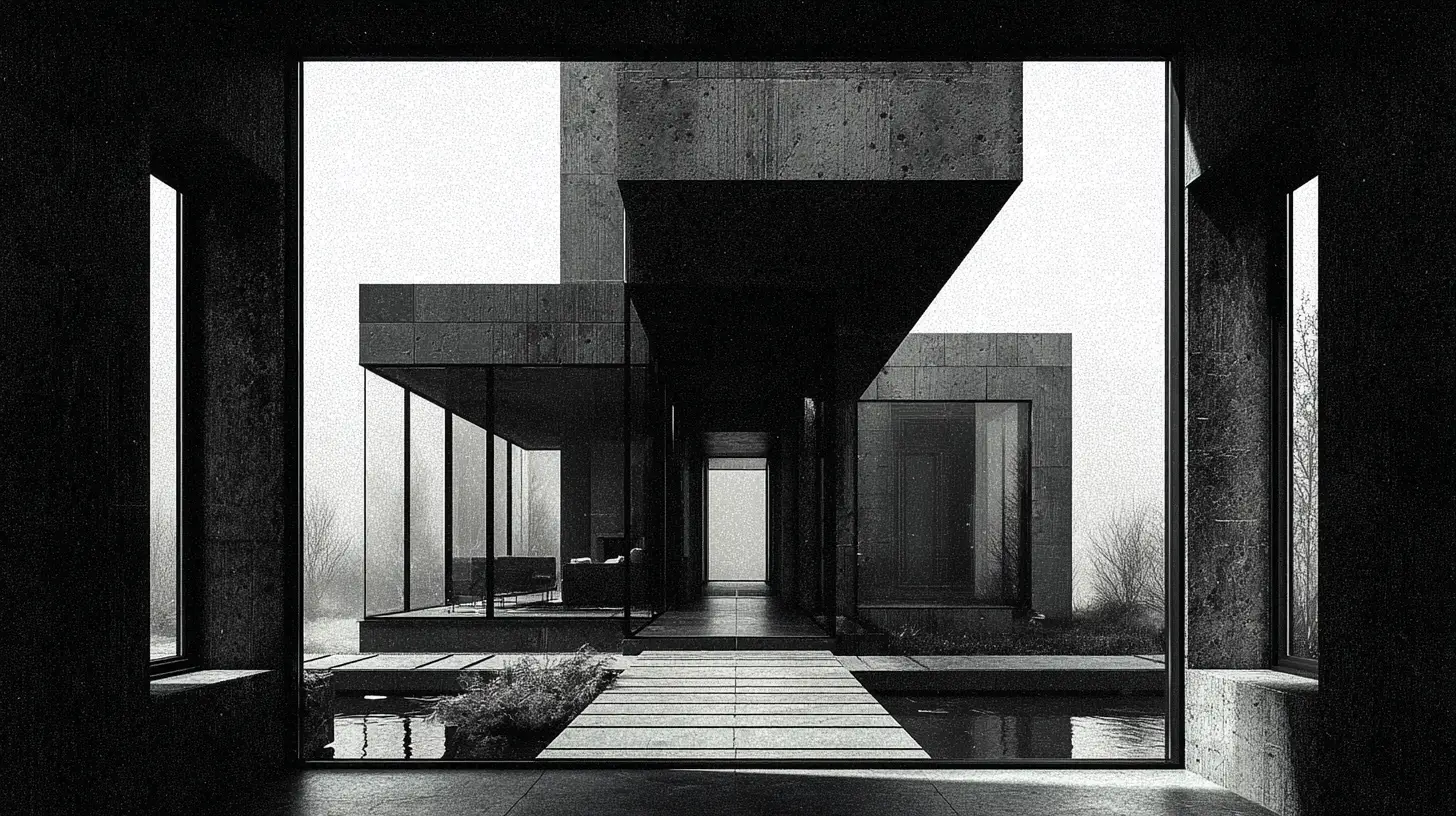
Black frames, slim metallic profiles, linear lighting fixtures, furniture bases, handles. These elements do not "color" the space—they define it. They create visual boundaries, emphasize proportion, and stabilize the composition.
The black line functions like the outline in a drawing:
without it, the form dissolves.
However, this line must be grounded in geometric precision. Black does not forgive inconsistency in joints, proportions, or lighting. If the geometry is weak, black exposes it.
Black as Depth: Materiality and Light
In interior design, black acquires substance through its relationship with materials. Unlike light tones that reflect and diffuse, black creates depth.
Next to natural wood, black enhances the warmth of its grain.
Next to raw stone, it intensifies the texture.
Next to matte plaster, it activates the shadow.
Shadow here is not a lack. It is a mechanism of highlighting. Without shadow, light acquires no form.
Proper lighting design is critical. In spaces with limited natural light, large black surfaces can perceptually shrink the volume. Conversely, in spaces with proper layering of light—natural and artificial—black acts as a conduit for contrast and clarity.
From Painting to Space: Shadow as Narrative
In art history, darkness was never absence; it was a tool of dramaturgy. The chiaroscuro* of the Renaissance proved that form is revealed through the contrast of light and shadow. Without darkness, the image remains flat.
Architecture draws from the same principle. Black in space is not just an aesthetic element but a narrative mechanism. It defines areas, directs movement, and creates focal points.
As in painting, so in the interior, the dark element intensifies the experience. It does not tell the story on its own; it creates the framework within which the story can exist.
Black and Raiment: The Line of the Body and the Line of Space
The sartorial history of black offers an interesting parallel. From mourning to modernism, black became a symbol of austerity and discipline. In contemporary fashion, it often functions as a “uniform”—a mantle of autonomy.
Technically, black clothing subtracts information. It does not compete with patterns or color intensities. It emphasizes the silhouette, the line, the structure of the body.
The same occurs in space. Black emphasizes the structure of the volume. It withdraws the gaze from decoration and turns it toward form. And just as clothing reveals the posture of the body, so a black interior reveals the quality of architectural thought.
Black and Society: Resistance to Saturation
Modern society produces a hyper-abundance of visual information. The colors of commercial environments are designed to stimulate, to mobilize, to accelerate.
In this context, the presence of black acts as a counterweight. It does not seek stimulation. It imposes concentration. It creates conditions of stability within an environment of overstimulation.
It is no coincidence that serious professional spaces, ateliers, galleries, and high-end residences adopt a disciplined use of black. It is not a matter of “luxury.” It is a matter of information control.
Black does not add stimulus. It reduces noise.
The Ethics of Black in Design
In architecture and interior design, black should not be used as a shortcut to making an impression. When it functions as a surface for display, without design infrastructure, it becomes heavy and aggressive.
Its responsible use presupposes:
balance with natural materials,
clear geometry,
meticulous lighting design,
limited surface area relative to the whole.
Black, more than any other color, demands consistency. And this demand makes it not just an aesthetic choice, but an ethical one.
In the arts, in fashion, in architecture, black is not a decorative gesture. It is an act of subtraction. It is structure. It is a boundary.
In space, black does not come to draw attention. It comes to organize the experience. To define depth. To give light the opportunity to exist.
It is not a color of sensationalism.
It is a color of discipline.
And for this reason, it remains timeless—not as a trend, but as architectural consciousness.
*( a painting and art technique based on the strong contrast between light and dark areas)