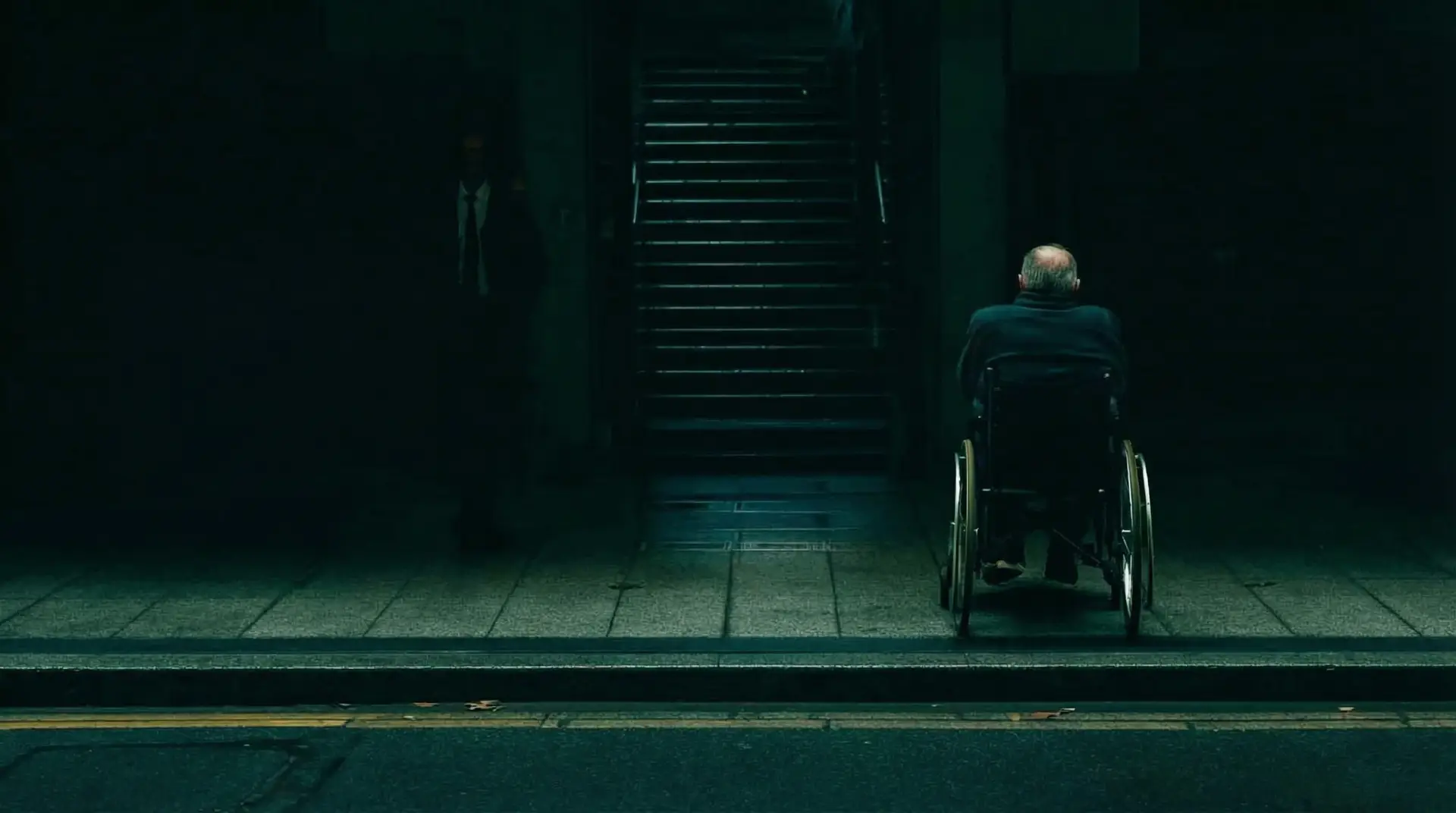
Inclusivity in design is often presented as a form of "sensitivity." In reality, it is something much more raw: it is performance. The performance of a space based on real people, in real conditions, with real constraints.
Written by
MOVA Studio · Architecture & Interior Design
An Athens-based studio shaping spaces where architecture, interior design and craft meet — notes from our practice.
Inclusion in design is often presented as a "sensitivity." In reality, it is something much more raw: it is performance. The performance of a space when applied to real people, in real conditions, with real constraints.
And constraints are not "special cases." The World Health Organization estimates that 1.3 billion people (16% of the global population, or about 1 in 6) live with a significant disability. In the EU, it is recorded that approximately 1 in 4 adults reports a long-term activity limitation. These are not margins. This is the population norm.
Therefore, every time we design a space that "works" only for the rested, young, able-bodied, neurotypical user with perfect vision/hearing and zero stress, we are not creating "premium." We are creating a space with a narrow functional range.
In engineering, this is simply called: a fragile system.
Inclusion is not a style. It is a right of access and a professional obligation
The UN Convention on the Rights of Persons with Disabilities (CRPD) in Article 9 explicitly speaks of access "on an equal basis" to the physical environment and to services "open or provided to the public." The framework is clear: we are not talking about "nice to have." We are talking about an obligation of access.
At a technical level, inclusion is not a narrative. It is a specification supported by international standards, such as:
-EN 17210:2021 (functional requirements/recommendations for accessibility and usability in the built environment)
-ISO 21542:2021 (requirements/recommendations for accessibility and usability of buildings)
The essence: you do not design for "a body." You design for a population.
How "premium" becomes an exclusionary filter in professional spaces
Exclusion in hospitality/retail/offices rarely happens with a "prohibited" sign. It usually occurs more "elegantly," through three mechanisms that look wonderful in photographs and tragic in use:
1) Removal of information
Minimal signage, low contrasts, doors that "disappear" into the wall, wayfinding that resembles an escape room. When the user cannot find the WC/exit/checkout without asking, the space is not minimal. It is stripped of function.
And here a hard truth emerges: asking for help with something elementary is not just a delay. It is a loss of autonomy. And autonomy is a basic unit of dignity.
2) Increased cognitive load
When a space "asks" the user to solve riddles (where do I go? where do I pay? where do I exit? what is this icon?), it increases cognitive load and stress, especially in unfamiliar environments. This does not "elevate the experience." It simply drives people away.
3) Risk transfer: slips and falls as a design product
Floors, stairs, level transitions, and wet zones are not "scenery." They are safety machines or accident machines, depending on how they are designed.
In the catering/hospitality sector, slips/trips are among the most frequent causes of serious injury, and official safety bodies treat them as a primary risk. This has a direct architectural translation: when you choose a finish that only works under ideal conditions (dry/clean/perfect lighting), you have designed a system that will fail at the first rain, the first cleaning, the first misstep.
A space that "shines" but increases the risk of injury is not premium. It is poor construction with beautiful photography.
Digital is part of the architectural experience (and must be accessible)
The modern experience is not just material: QR menus, bookings, kiosks, forms, portals. If the digital layer "breaks," the space is not functional.
WCAG 2.2 (W3C Recommendation) is the international baseline for digital content accessibility. In practice, this means: readability, navigation, correct sizes/contrasts, the ability to use it without a "perfect hand/eye/patience." If it is not there, the service is not "luxury." It is partially unavailable.
The residence, where "hollow design" doesn't just exclude, it injures
In professional spaces, we talk about equal access and experience. In the residence, something heavier is added: safety and independence.
Falls at home are among the most significant risks for older adults and are linked to environmental factors: slippery surfaces, steps, loose rugs, inadequate lighting, clutter, poor layout. The WHO has dedicated an international report to the prevention of falls in older age, and the CDC (STEADI) provides practical tools/checklists for risk prevention within the home.
Translated into an architectural brief, a residence that "works" only when you are 100% is fragile. And life is not static: age, injury, surgery, pregnancy, chronic pain, reduced vision, neurological difficulties, fatigue. The body changes. Therefore, the residence must have tolerance and forgiveness, like any proper system.
What "inclusive residence" means in practice
Without getting into fake "trend" lists, the essence is specific:
Safe paths (especially bedroom → WC at night) with proper lighting and a clear "reading" of boundaries.
Non-slip surfaces in wet zones, correct detailing in transitions, and avoiding "glassy" finishes where they shouldn't be.
Functional stairs (not "sculptural statements"), with safety, clear information, and proper lighting.
The bathroom as a critical space: if its design requires perfect balance and perfect movement, it is a design for an accident.
A kitchen that doesn't punish: ergonomics, access, maneuvers, avoiding solutions that require constant bending/climbing.
Clear "spatial language": the space should "speak" with information (not hide it so as not to spoil the frame).
In the home, premium is not marble. It is risk reduction and the preservation of independence.
Part of luxury sells exclusion
There is an uncomfortable reality: a large part of "premium" aesthetics gains value because it stands out. And sometimes, "standing out" is not a functional advantage, but a social filter. A space where you feel you "belong" only if you have a specific body, pace, energy, and confidence.
The Design Justice approach is correct in its basic argument: when you design around an imaginary "neutral" user, you effectively erase groups. Inclusion is not PR. It is a choice to see the real population, not the moodboard.
Conclusion: two demands that change the game
Design that "shows" but does not "work" is not an aesthetic choice. It is selective function. And selective function, in spaces meant for people, is equivalent to exclusion, whether we are talking about professional spaces/services or the home as a system of safety and independence.
Designers of all kinds must return to the basics: designing for real people, not for renders. Inclusion is not a moral accessory; it is a professional standard. It translates into specifications, technical control, documentation, and solutions that endure real life: rain, cleaning, low lighting, fatigue, different abilities, and different rhythms of use. If a choice cannot prove that it works consistently in the field, then it is not design—it is styling.
The stance of clients must become equally clear. Inclusion is not "stuck on" at the end as an add-on; it is built from the beginning into the brief, the budget, and the process (analysis, specification, testing, verification). When you buy only an image, you get an image. When you demand and fund measurable performance, you get real value: less risk, fewer failures, fewer accidents, more autonomy and dignity in daily use.